![]() |
|||||||||
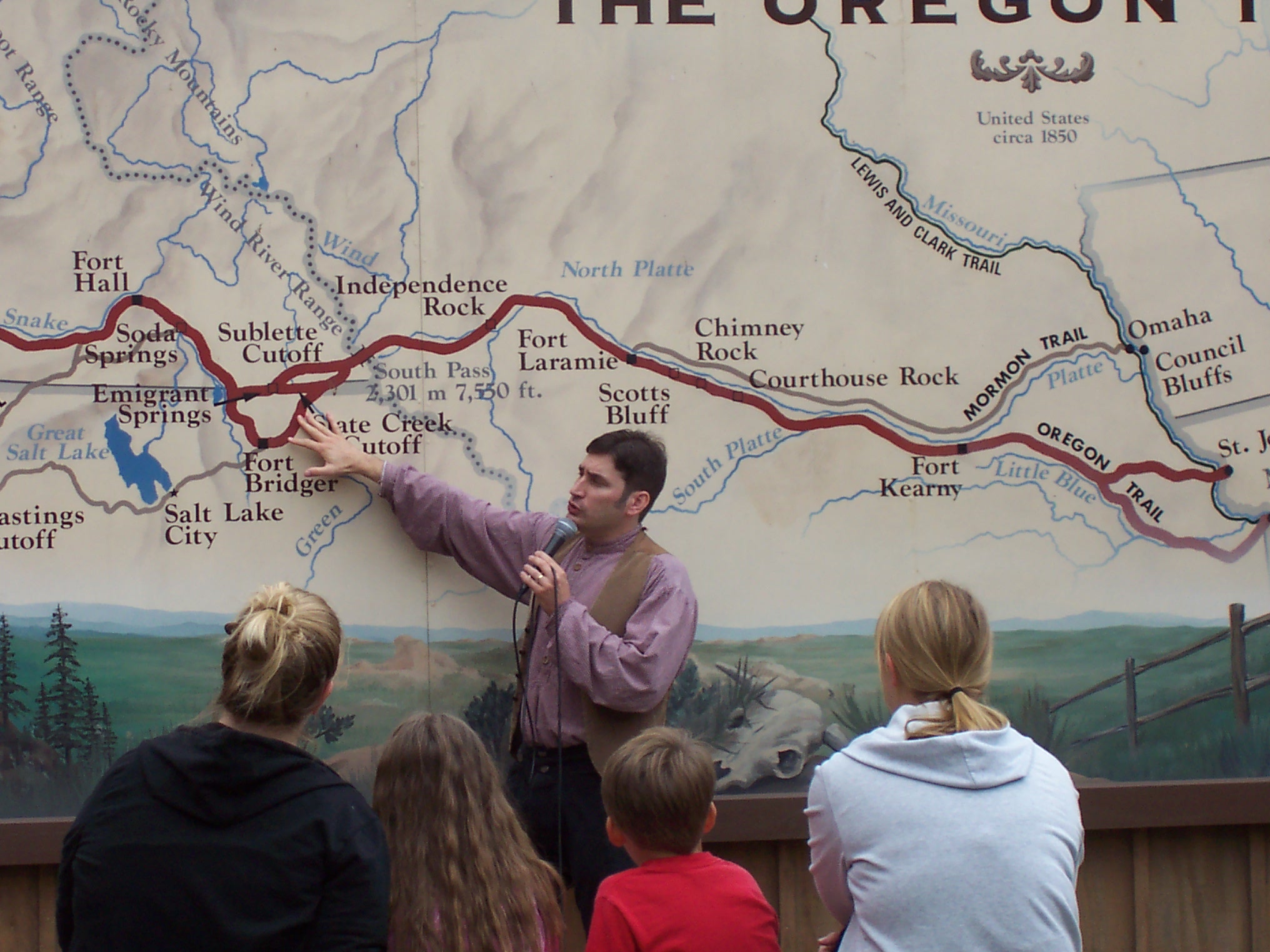
| Oregon Trail Map Library We selected the following maps for their historic significance, educational value, and general relevance to the topic at hand. Note that some of these maps are rather large -- you will have to scroll extensively to get a good look at them in your browser window. Other early maps of Oregon and the Pacific Northwest are available at the Web site of the Oregon Historical Society [www.ohs.org]. Map of the Oregon Trail Click on the main map to bring up maps of the Trail's route within Oregon, Idaho, Wyoming, and Nebraska. Relief maps of individual states appear courtesy of Ray Sterner and the Johns Hopkins University Applied Physics Laboratory [fermi.jhuapl.edu/states]. Thanks also to Xerox PARC for their now-defunct public domain map generator. Note that if you're looking for a map with which to plan an Oregon Trail vacation, we'll happily send you one if you e-mail a request to us along with your (actual, physical) mailing address. We won't even add you to our mailing list unless you ask us to. Promise. If you'd like to browse through a clickable map of the Trail as it winds through the great state of Oregon, click on over to tomlaidlaw.com. Map of the California Trail Despite the fact that this Web site belongs to the Oregon Trail Foundation, we get requests from time to time for maps and historical information on the California Trail. Fortunately, the Oregon-California Trails Association has produced a "virtual tour" of the California Trail which cleverly provides a map that's linked not only to information on the history of the California Trail, but also to useful information for modern overlanders who want to follow in the footsteps of the pioneers. Check out OCTA's home page at [www.octa-trails.org] or follow the above link directly to the map. Map of the Trans-Mississippi West You have to work a little to get this one, as it lives in a database at the Library of Congress and can't be permanently linked. Follow the link to the search page and type in fur trade -- the item at the top of the list you get back should be entitled "Map of the Trans-Mississippi of the United States during the period of the American fur trade as conducted from St. Louis between the years 1807 and 1843." It is the most detailed and accurate map of early western outposts we've yet found on the Web. Note that this map dates from the period before the United States took control of California and the Oregon Territory, so it shows the international borders as they were at the opening of the Oregon Trail era. You can use the online viewer or download a high-resolution image of the map. Tribal Territories Gallatin's Map of the Indian Tribes of North America (580K) was among the most comprehensive surveys of Indian lands available in the mid-Nineteenth Century. It appears here courtesy of the American Antiquarian Society. Indian Tribes of the Oregon Country (650K) Before the pioneers and fur traders arrived, the present-day states of Oregon, Washington, and Idaho were home to scores of native tribal cultures. Color coding on this map reflects language groupings, not political affiliations or military alliances among the tribes. It's also important to recognize that Indian tribal territories were rarely stable for long -- note how the distribution of the Molalla-Cayuse language group was fragmented into three discrete areas, suggesting migrations and episodes of warfare in the past. Similarly, the language group shared by the Coquille, Upper Umpqua, Klatskanie, Kwalhiokwa, and a few smaller tribes not shown on the map is called "Athabascan" -- the namesake Indians of this linguistic group, the Athabasca, are a Canadian tribe. Finally, observe the smaller tribal territories clustered on the western edge of the map; the increased population density among coastal and valley tribes was a result of the greater abundance of food in these regions as compared to the high desert and inland mountains. Source information for this map came from the Oregon Historical Society. 1838 Map of the West (130K) Samuel Parker was sent to the Oregon Country to scout locations for new missions. While he was in Oregon, he consulted with the Hudson's Bay Company and combined their knowledge of the area with what he had learned on his own journey west. Much of the information conveyed in this map was probably gathered by explorers like Simon MacKenzie, John C. Fremont, and Peter Skene Ogden. The primary value of this map from an interpretive standpoint is its focus on rivers, rather than the actual geography of the land. This focus is intentional -- rivers were the highways of the pre-industrial age, and the confluence of two significant streams was a reliable way for explorers and mountain men to figure out where they were or to describe a rendezvous point. Also significant is that Parker did not include California. This seems odd today, but bear in mind that in 1838, California belonged to Mexico. The approximate route of the Oregon Trail is marked -- very approximate, as the map is far from accurate by modern standards. (Map courtesy of the Oregon Historical Society, map #367) 1849 Re-Survey of San Francisco (350 K) The City of San Francisco was founded by the Spanish in 1776 as Yerba Buena ("Good Herb"), and it was resurveyed after passing into American hands. The plat had to be sent up the coast to be filed in Oregon City because at that time, it had the only federal land office west of the Rockies. Also of interest are two accompanying letters: one, written by surveyor William Eddy, grants power of attorney to a ship's captain to file the plat on his behalf "regardless of expense"; the other is a record of the plat's filing which was sent back down the coast to Mr. Eddy. It is a point of local pride that the original survey of one of the world's great cities belongs to the Clackamas County Historical Society. (Map and accompanying documents courtesy of the CCHS) 1852 Survey of Township 2 South, Range 2 East (340K) This township survey of the area around Oregon City illustrates the level of detail apparent in early surveys of Oregon. Straight grid lines on the map indicate the paths actually walked by Joseph Hunt, the surveyor who took the field notes from which the map was produced. Hunt also drew the map, though in later years, the jobs of field surveyor and cartographer were generally separate specialties. The last few miles of the Oregon Trail are visible on this map -- look for a road labeled simply "Oregon City to Fosters," referring to the farm of Philip Foster. Note that the road ends on the claim of George Abernethy, the present-day site of the End of the Oregon Trail Interpretive Center. (Map courtesy of the Bureau of Land Management) 1861 Survey of Land Claims in T2S, R2E (310K) This survey covers the same ground as the 1852 survey, but instead of the land itself, it shows the boundaries of land claims north and east of Oregon City. Note that some of the claims, such as those of George Abernethy, Ezra Fisher, and Isom Cranfield, have slightly more than the 640 acres which they were permitted under Oregon's first constitution and the Donation Land Act, which superseded local provisions for establishing land claims. Such overages resulted from inaccurate surveys, and they only occur in the earliest land claims. (Map courtesy of the BLM) 1863 Survey of the State of Oregon Four years after statehood and six years before the driving of the Golden Spike, this map is a good representation of the population distribution within Oregon as the Oregon Trail era was drawing to a close. Of particular interest is the fact that this survey notes both proven and suspected gold fields in eastern Oregon, a powerful comment on the importance of precious metals to western settlers. For faster downloading and easier viewing, select the color-coded version of the survey (100K) -- all of the information of the original, but little of the charm. (Map courtesy of the Oregon Historical Society) |
|||||||||