|
|
|||||||||||
Elijah & Catherine Oliver
Emigrants of 1864
|
|||||||||||
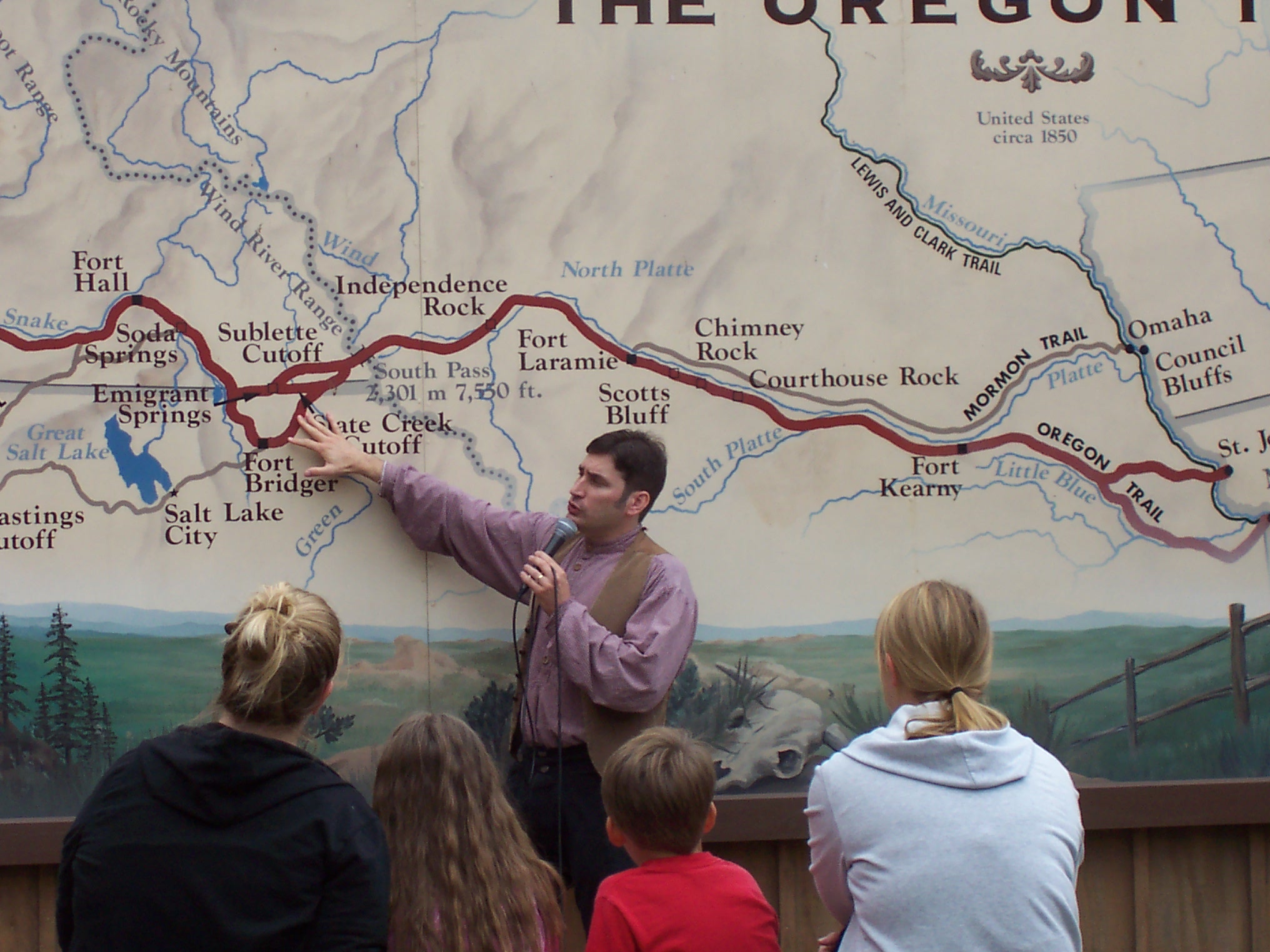
| I was born in a one-room log cabin on a farm in Marion County, Iowa, March 10th, 1856. My grandfather on father's side was descended from early New England stock, and grandmother on father's side was a descendant of the Boone family of Kentucky. Both grandfather and grandmother on mother's side were descendants of "Pennsylvania Dutch," Quakers who came over with William Penn. In the early 50's and 60's everything was very primitive, everything was home made. Flax and wool were produced on the farm and spun and woven by the women at home and made into clothing. Some women became very adept at the loom and also at tailoring. However, the most expert could not make a suit of clothes to compare with a cheap suit of today. However, the clothes kept us warm. Of course, gas, electricity, telephones, automobiles, and radios were undreamed of in those days. Our illumination was mostly provided by an open fireplace. On special occasions we had tallow candles, but they were a luxury. Some of the "Upper Ten" had whale oil lamps but they were few and far between and only the very "wealthy" could afford them. Coal oil had not yet come into use. I learned my A-B-C's from McGuffy's spelling book and learned to read from McGuffy's readers and the family Bible. Father taught me to write and to "figure" in addition, subtraction, and division. I never saw the inside of a school house until I was 13 years old. I believe The Oregonian was the first newspaper I ever saw. We crossed the plains to Oregon in 1864 by ox team and covered wagon and were over six months on the road from Omaha to La Grande. An ox team is not geared for high speed and 1 1/2miles per hour is about their limit. We stopped at Omaha several days for outfitting and the gathering of more emigrants as the Sioux Indians were on the warpath that summer and it was not safe for a few people to venture alone on the trip. Many emigrants arrived daily and when we were ready to start there were more than 100 wagons in our train and twice that many men, all armed, mostly with single shot, muzzle loading rifles. Some, however, had Henry rifles and Colt revolvers. We had a captain and other officer, all ex-soldiers. In fact, we had a regular military organization, guards at night and scouts by day. The Indians never attacked our train but they tried to stampede the horses in two or three early morning raids, and did get away with nine horses in one raid. This raid was within a few miles of Fort Laramie. The soldiers from the Fort came out after the Indians but they made a mistake and ambushed a party from our train and killed a couple of horses and wounded two men in the skirmish and it was difficult to prevent our party from cleaning out the soldiers. For several weeks Indians were in sight every day, following along parallel to the road, hoping to pick off stragglers. Several times, when the wind was right, they set fire to the prairie. Then we had to set a backfire and move into the burned space and corral the wagons and prepare for an attack, which, fortunately, never came. We had several wind storms and terrific thunder storms along the Platte River, mostly at night. Tents blew down, wagon covers were blown to ribbons, rain fell in torrents, and everything was soaked. Then we would have to lay over for a day to dry out. Several parties in our train had good four-horse teams and a few had mule teams. They could travel much faster than the ox teams and consequently many became impatient and wanted to leave the main train, but our captain seriously objected on account of danger from Indians. Two or three families, however, decided that they knew more than the captain of the train and pushed on ahead. A few days after leaving our party we found their mutilated bodies and the remains of their wagons. The horses, of course, had been taken by the Indians. None left the train after that until we got out of the Indian country. After we reached the Rocky Mountains all danger from Indian raids ceased and somewhere in what is now Wyoming the road forked. One road led to California and the other to Oregon. There the train divided and most of the people went to California. We crossed the Snake River at old Fort Hall. After crossing the river we filled every barrel, bucket, and bottle with water for the trip across the lava beds. We traveled two days and two nights before we got to water on Lost River and the cattle by that time were about famished, and the men, women, and children were completely worn out. Women and children were crying, and even the dogs tucked their tails between their legs and looked pitifully at their masters, mutely begging for water. We laid over a day or so for rest and then proceeded again, fording the Snake River a second time near the mouth of the Owyhee River. The Snake River was very swift here and several mules were drowned in the crossing. There were no bridges on the road between Omaha and La Grande. All streams had to be forded. We lost one yoke of oxen on the road in Wyoming and arrived in the Grand Ronde valley with one yoke of oxen and an almost empty wagon about November 1st, 1864. We thought our troubles were over, but they were hardly begun as we soon found to our sorrow. The first thing to look for was a house or some kind of shelter for the winter and the only thing we could find was a deserted shanty built of cottonwood poles and roofed with poles and sod. The shanty was about 10 x 12 feet and had a dirt floor. It had a large fireplace and a chimney built of stones and mud. The windows were about 10 x 12 inches covered with greased paper for "glass." There was but one door and it opened outward. Soon after our arrival at the shanty there came a heavy rainstorm and our sod roof, being dry and sun-cracked, leaked like a sieve and the dirt floor was a quagmire. Soon after the rain storm it began to snow and it continued to snow until it was four feet deep on the level. Then there came a windstorm and drifted the snow. The next morning we found that the drifted snow had piled high against the shack and lodged against the door, effectually closing it. It therefore devolved upon father to climb up the chimney and shovel the snow from the door to permit us to get outside. This performance was repeated several times during the ensuing winter. There were no flouring mills in the valley at that time. All flour and staple groceries had to be hauled from Walla Walla, and as the heavy snowfall early in the season was unexpected the limited supplies in the valley were soon exhausted. Flour was one dollar a pound, and coffee, sugar, and other staples were unobtainable. The last sack of flour we got in the fall we traded for our last yoke of oxen. Father secured several days' work making fence rails at $2.00 per day and took his pay in wheat, potatoes, and onions; also a keg of syrup. After our sack of flour was gone we ground wheat on a coffee mill to make our bread, and used parched wheat for coffee and boiled wheat for hominy. Father killed an elk early in the winter and, after dividing with our nearest neighbor (seven miles away), salted part of it and "jerked" the balance. This, with an occasional piece of beef and several prairie chickens, lasted us until spring. After the snow went off (about the 1st of May) we had plenty of trout. Matches were another scarce article and very few people had any. Therefore it became necessary to keep a small fire going all the time. Our fire was put out once by snow drifting down the chimney and we had no matches. As the nearest neighbor was about seven miles away, it was impossible to carry fire that distance. (The neighbors had no matches either.) Father put a small charge of powder in his rifle, got some kindling ready, then shredded a cotton rag and put it loosely into the rifle. The flash of the powder set the loose rag afire. This was placed under the prepared kindling and we soon had a fire going. Along about the first of July, 1865, we began to figure a way to get out of there. We had an old dilapidated wagon, but nothing to pull it. We finally found a man who wanted to get out of there as badly as we did. He had a span of horses and an old set of harness so we formed a "merger" and agreed to give him the wagon if he would bring us to Portland, Oregon.The roads were in a terrible condition and the streams were high. There were no bridges across any of the streams except the Deschutes and Sandy River at Revenue. We forded the Umatilla, John Day, and all other streams. We crossed the Cascade Mountains over the old Barlow Road, now a part of the Mt. Hood Loop Highway. We forded the Sandy River near Zig Zag and came down the Backbone Road to a point this side of Marmot, Oregon, where we eased the wagon down the bluff with ropes and crossed the Sandy River on the Revenue bridge. The horses were unable to pull the almost empty wagon up the old bluff on this side of the Sandy River, so we had to hire an ox team from Francis Revenue to pull us up the hill. After leaving Revenue we wandered along through dense timber and came down Johnson Creek to Milwaukie, Oregon, where we crossed the Willamette River on a ferry and came down the Macadam Road to Portland, where we arrived in August, 1865. Here the "merger" was dissolved by mutual consent and my father's brother met us with a team and took us on to a farm near Cedar Mills, about five miles west of Portland. We lived on the Cedar Mills farm until 1867 when we moved to Portland, where I have lived since that date.
|
|||||||||||